
By Nina Hirai
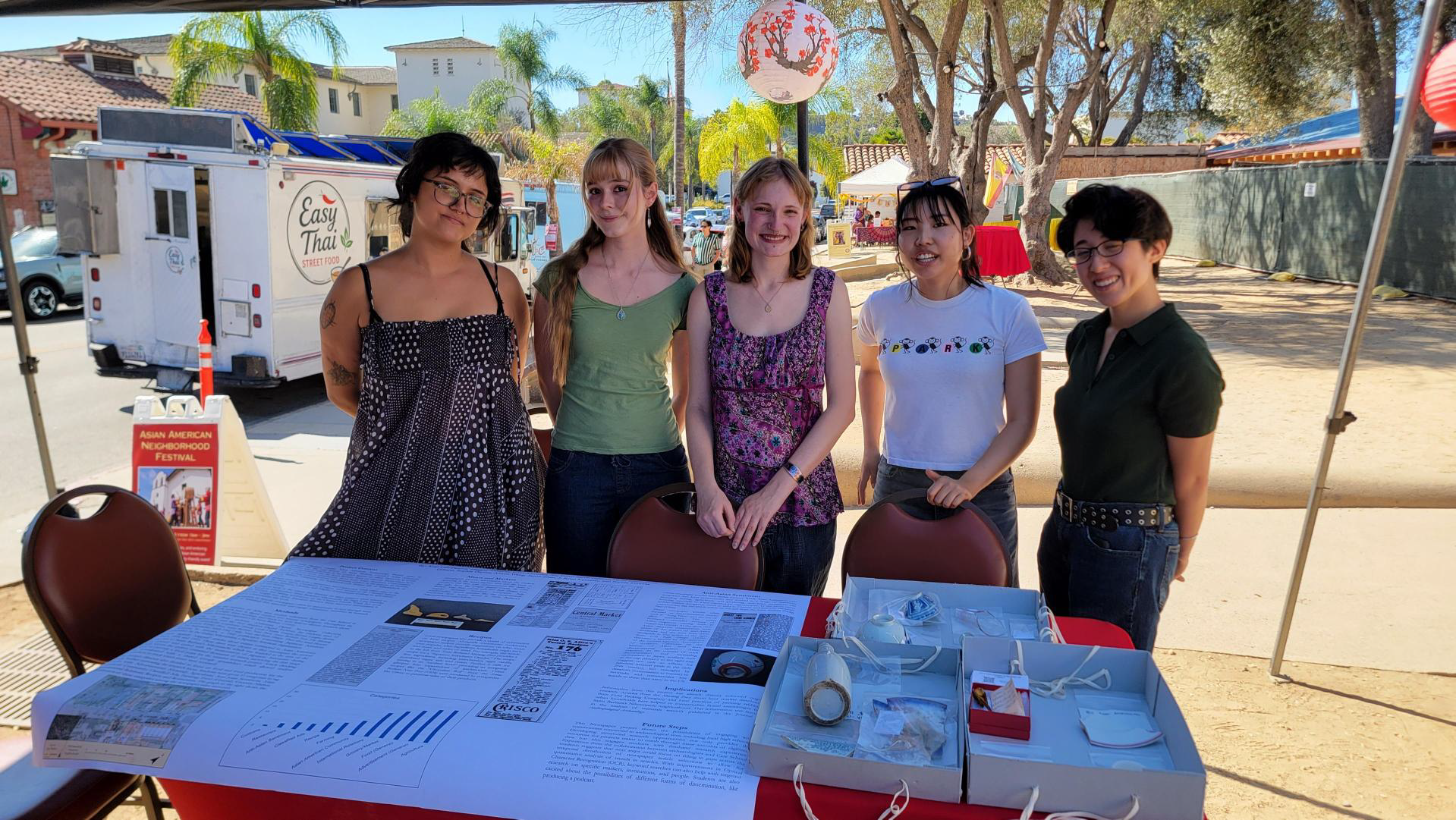
UCLA Asian Diaspora Archaeology Lab student representatives (from left), Montse, Kat, Giada, Nina, and Emily, tabling at SBTHP’s annual Asian American Neighborhood Festival on Sunday, October 18, 2026. Photo by Michael H. Imwalle.
Crammed in the back of a small car at 7:00 am is not usually how I would volunteer to spend my Sundays, but when I was asked by my advisor Dr. Koji Lau-Ozawa to help table at SBTHP’s Asian American Neighborhood Festival in downtown Santa Barbara, I was more than happy to wake up before the sunrise.
It was only halfway into our two-hour drive that I realized this was my first time leaving the city of Los Angeles since moving in September for the start of my Ph.D. program at UCLA. With it being my first time attending SBTHP’s Asian American Neighborhood Festival, I honestly didn’t know what to expect. Would people even care about our little table of artifacts, or would I just be standing awkwardly at a table for a whole afternoon?
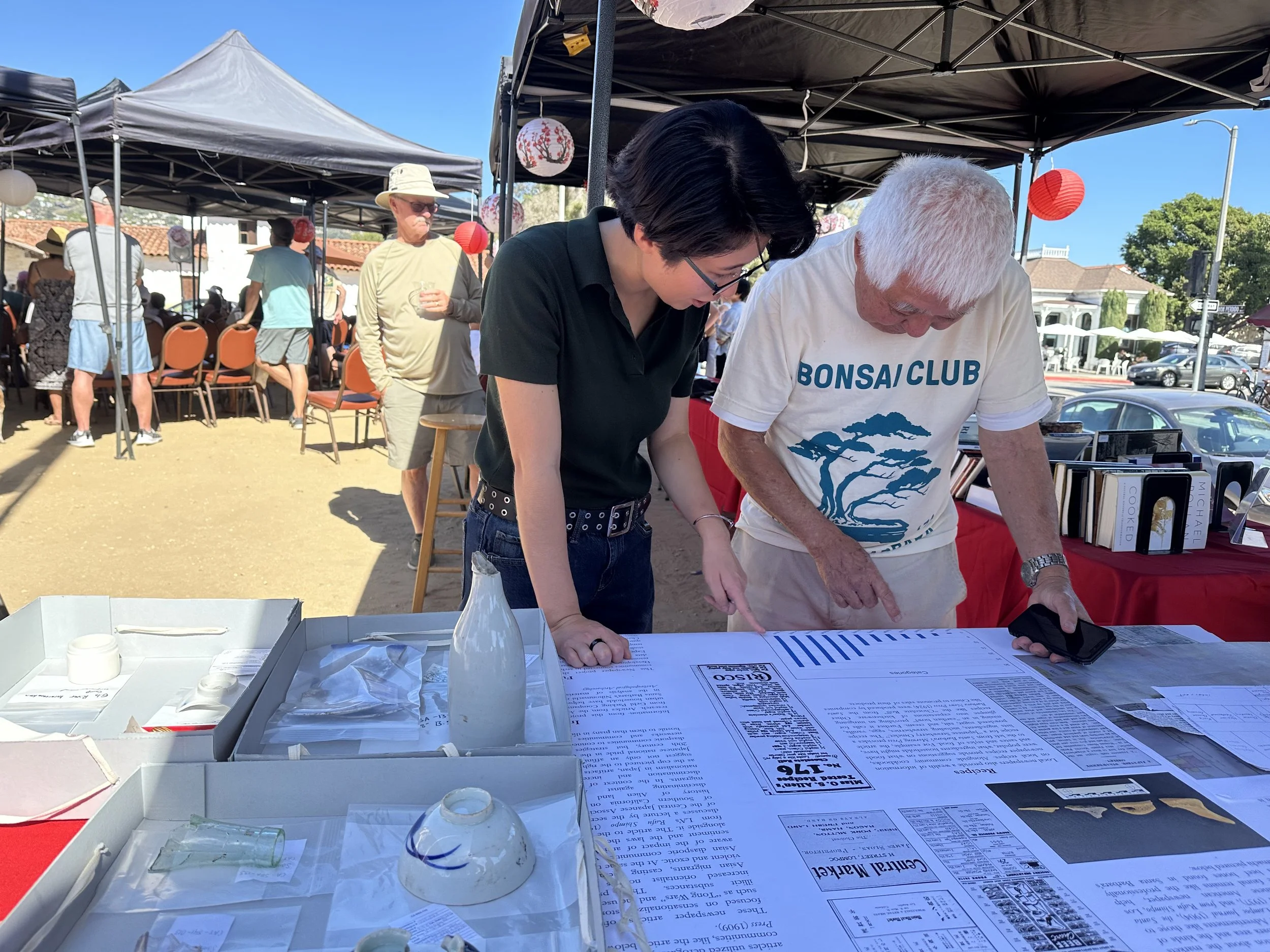
UCLA Anthropology graduate student Nina Hirai shares data with a festival attendee. Photo by Nina Hirai.
To my pleasant surprise, there was a lot of interest from passersby and members of the community who eagerly asked us about the various items we had brought with us. The artifacts that I, along with a small group of undergraduate students from UCLA, presented at our festival table were from Santa Barbara’s former Japantown, also known as the Nihonmachi. These items were excavated at El Presidio de Santa Bárbara State Historic Park in the heart of the historic Presidio Neighborhood.
Back in the 1960s and 1970s, before the northern Presidio buildings were reconstructed, a team of volunteer researchers conducted archaeological excavations of the area to try and find the original Presidio building foundations to make the reconstruction as accurate as possible. In doing so, a whole bunch of Nihonmachi artifacts were unearthed.
While these artifacts were not fully processed or analyzed at the time (artifact processing is time-consuming and expensive), we at UCLA’s new Asian Diaspora Archaeology Lab (directed by Dr. Lau-Ozawa) have been working closely with the Santa Barbara Trust for Historic Preservation to clean, analyze, and rehouse (in archival-safe storage) the excavated Nihonmachi materials. These early twentieth-century artifacts are important to our understanding of the Japanese American community in Santa Barbara as they are the only physical remains of the neighborhood.
Santa Barbara’s Nihonmachi was an area that spanned along the 800 block of Anacapa Street and the 100 block of East Canon Perdido Street. Today, while no structural remains of the historic neighborhood exist, the various artifacts left in the dirt can help us uncover the kinds of lives those in the neighborhood might have led. The 1910 Federal Census Records report that a total of 36 Japanese residents (28 men, 5 women, 3 children) lived in the Presidio area (along Anacapa and East Canon Perdido Streets). By 1924, there were grocery stores, boarding houses, a Buddhist temple, and even billiard halls run and operated by Japanese/Japanese-descendant community members.
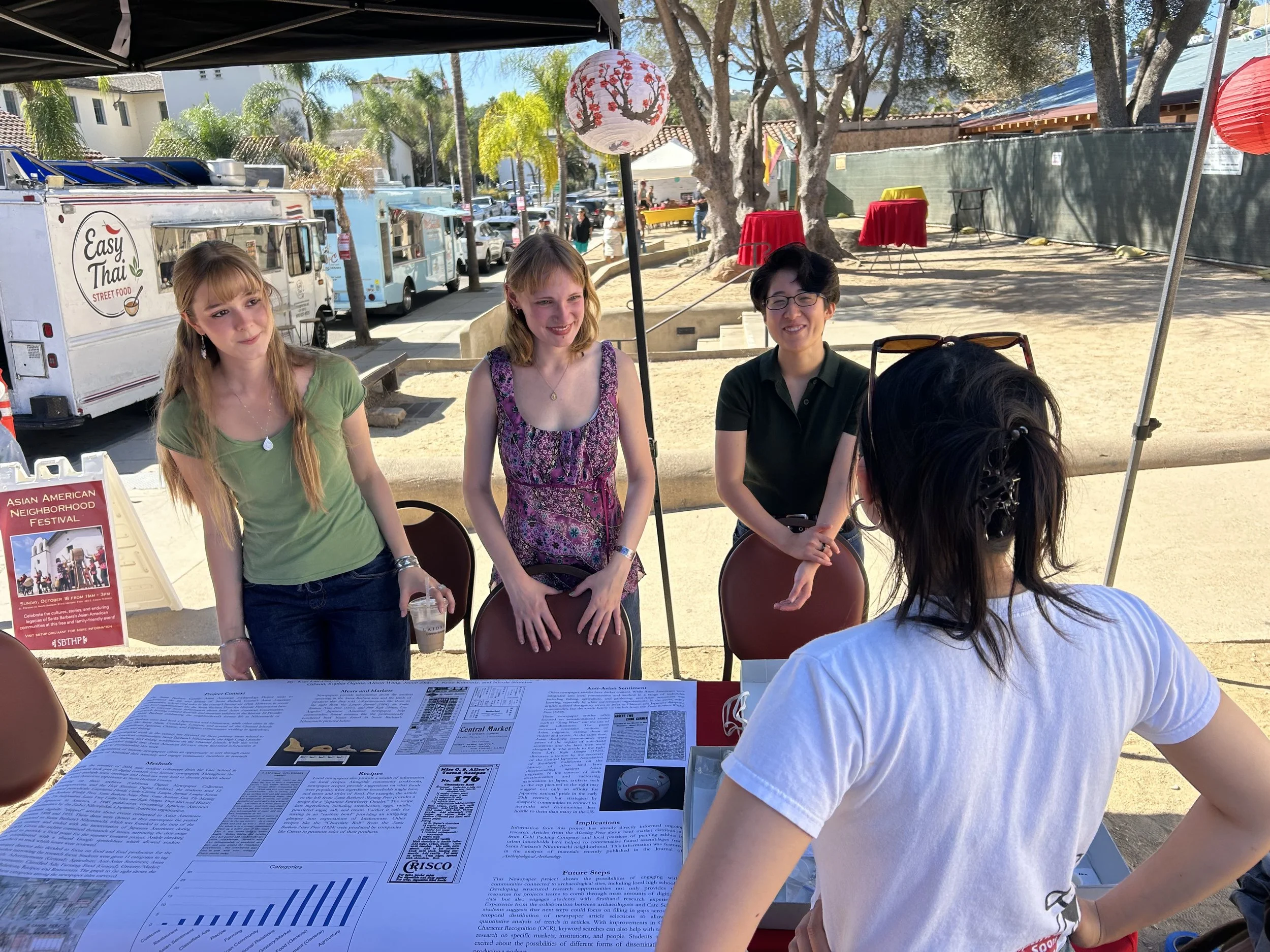
Kat, Giada and Nina welcome a festival goer to the UCLA Asian Diaspora Archaeology Lab table. Photo by Nina Hirai.
Although the Immigration Act of 1924 banned Asian immigrants’ entry into the United States, Santa Barbara’s Nihonmachi community was still active; its population growing into the early 1940s. However, life for the community suddenly changed in 1942, at the height of World War II, when Executive Orders 9066 and 9102 were issued. Members of the Santa Barbara community who were of Japanese descent were forcibly removed from their homes, despite many of them pledging allegiance to the United States, and/or being American citizens, themselves.
The artifacts unearthed in the Presidio area are thus not only a testament to the lives brutally uprooted but also to the resistance of the Japanese American communities who once hoped to return to their homes and their community in Santa Barbara.
In this way, it was a truly gratifying experience to bring back some of the artifacts to their home, and to connect with members of the Santa Barbara community to share the history of these items and the Nihonmachi. It was very beautiful to witness the care, commitment, and excitement that many of the community members had regarding this history, whether they were unaware of it or had personal connections to it. Many members even shared their own memories of their parents, grandparents, or friends who had experienced this era of Santa Barbara. I was truly grateful to have learned from community members.
Sometimes when you analyze twenty ceramic sherds in a row, you lose sight of the significance and history you are interacting with. It is by bringing these historic materials back to the community and sharing their history that these artifacts truly shine and come back to life.
I would like to say thank you not only to the Santa Barbara Historic Trust Preservation and the Asian American Affinity Group for having us and trusting us with these artifacts, but also to the festival attendees and members of the Santa Barbara community who welcomed us with open arms and helped us to bring life back to these invaluable artifacts.